Evening light and your body clock: what a screen can and can't do
A screen's effect on the body clock is mostly melanopic light, not a "blue light" percentage. On a P3 panel, about 72% of that signal is in the blue channel and about 28% is in the green; red contributes almost none (CIE S 026 weights, applied in docs/RESEARCH.md §13). Warming helps. Dimming helps too, because the same spectrum at a lower luminance is less alerting. Atapa's evening ring is that estimate against an untouched screen. It is not a sleep measurement, and we do not claim one.

Kevin Hofmann, maker of Atapa. Updated .
This page explains the one number Atapa shows about light, how it is computed, and where it stops. It is written by the people who make Atapa, and it makes no claim about your sleep.
What is melanopic light, in plain words?
Your retina has a small set of cells that do not help you see shapes. They measure how bright the world is and report it to the body clock. Their pigment, melanopsin, is most sensitive to light around 480 nm, in the blue, and much less sensitive to red. Light weighted by that sensitivity is melanopic light. CIE S 026:2018 is the international standard that defines the weighting, and Lucas et al. 2014 is the paper that argued for measuring light this way instead of by lux alone.
So the question for a screen in the evening is not “how much blue light does it block” but “how much melanopic light does it emit”. The first has no shared method; the second has a standard.
Why blue is about 72% and green about 28%
A white screen is three primaries added together. To know how much of its melanopic output each channel carries, you weight each primary’s spectrum by the CIE S 026 melanopic function and by the primary’s share of white luminance.
For an Apple-style P3 panel we modelled a 450 nm blue LED, a 533 nm green phosphor and KSF red lines at 613, 631 and 648 nm, with P3 luminance shares of 0.229, 0.692 and 0.079. The melanopic-to-luminance ratios come out at 0.0023 for red, 0.614 for green and 13.57 for blue, and the channel shares at:
| Channel | Share of a white P3 screen’s melanopic output |
|---|---|
| Blue | 0.717 |
| Green | 0.283 |
| Red | 0.0004 |
Broader P3 primaries give 0.000, 0.313 and 0.686. An sRGB white-LED monitor gives 0.004, 0.252 and 0.743. The split moves a few points between displays, which is why the app always says “about” and “estimate”. It replaced an earlier guess that weighted green at 10% and overstated the effect; green matters more than the “blue light” framing suggests.
Why dimming matters as much as warmth
Warming a screen removes blue and green. Dimming it removes everything in proportion. Melanopic light scales with luminance, so the same spectrum at half the brightness is half the melanopic output. The two effects multiply: a warm, dim screen emits far less than a warm, bright one.
That is why Atapa’s evening curve dims as it warms, and why it can dim below the lowest brightness step of the hardware. It is also why a mild orange at full brightness, which is what Night Shift gives at More Warm, still leaves a lot of melanopic light on the screen.
What the ring estimates
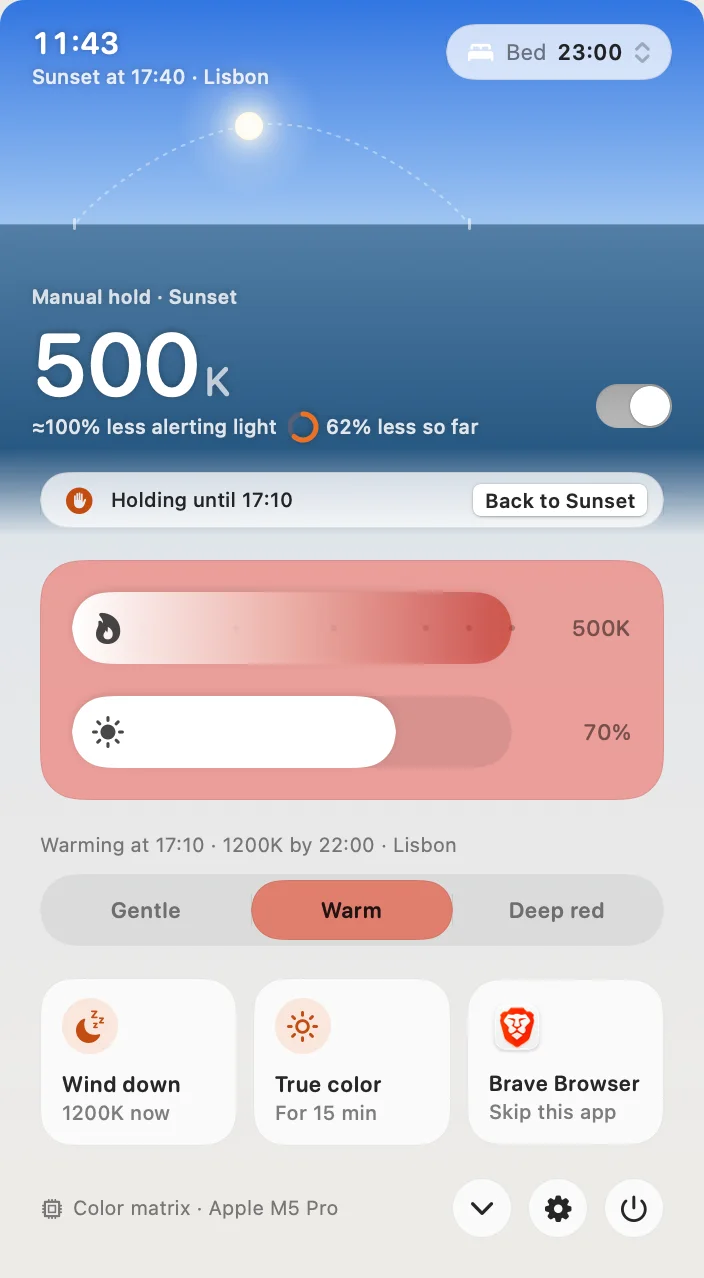
Atapa’s popover shows one ring: “about x% less alerting light”. It is the melanopic estimate for the current tint against an untouched screen, from the linear output multipliers for warmth, Readable red and dimming. In Statistics it is tracked per evening, from 18:00 to 06:00; time with the tint off counts as 100%, and a sleeping display is not counted.
At 100% brightness, Atapa’s own color math gives these reductions. Each value is simulated with Atapa’s own color math on the P3 panel model, not measured on your display.
| Warmth | White point on the screen | Melanopic light, less than an untouched screen |
|---|---|---|
| 6500K | #FFFFFF | 0% |
| 5500K | #FFF4E2 | 20% |
| 5000K | #FFECD1 | 31% |
| 4300K | #FFE0B4 | 46% |
| 3400K | #FFCA86 | 66% |
| 3000K | #FFBE6E | 74% |
| 2700K | #FFB359 | 80% |
| 2300K | #FFA139 | 87% |
| 1900K | #FF8B00 | 93% |
| 1500K | #FF6D00 | 96% |
| 1200K | #FF4F00 | 98% |
| 1000K | #FF3100 | 99% |
| 800K and below, Readable red | #FF0000 | 100% |
Dimming multiplies the remainder. At 2700K and 90% brightness, the remainder is 0.20 times 0.9, so the ring reads about 82% less. At 500K with Readable red the estimate reaches about 100%, because the green and blue outputs are zero; the small red output carries almost no melanopic weight. Night Shift’s warmest step, around 2700 to 3000K by independent measurement, lands near the 74 to 80% rows at full brightness.
What the research does not show
The papers below show that melanopsin drives the body clock, that its sensitivity peaks in the blue, and that evening light should be dim and low in melanopic content. Brown et al. 2022 give a recommendation for the three hours before bed in melanopic terms. Cajochen et al. 2011 found that an LED-backlit screen in the evening affected circadian physiology and alertness compared with a less blue screen. Spitschan 2019 reviews what melanopsin does and does not contribute.
None of that is a study of Atapa, and we have not run one. We do not claim that Atapa improves sleep, raises melatonin, or is medically proven. We do not publish a “blue light blocked” percentage, because the figures on vendor sites share no method. We do not claim to remove PWM flicker: the backlight of a MacBook Pro flickers in hardware, and no software changes that. What we claim is narrower: Atapa reduces the screen’s melanopic output, by about the amounts in the table, as an estimate.
Sources, and what each one says
- CIE S 026:2018 defines the melanopic weighting function and the five alpha-opic quantities. It is the standard behind the 72/28/0 split.
- Lucas et al. 2014, Trends in Neurosciences, argues for measuring light by its melanopic content rather than by lux alone, and supplies the toolbox that later work uses.
- Brown et al. 2022, PLOS Biology, is a consensus recommendation for indoor light across the day: bright and melanopic-rich in the daytime, dim and low in melanopic content in the evening and at night.
- Cajochen et al. 2011, Journal of Applied Physiology, is an evening-screen study: an LED-backlit screen with more blue affected circadian physiology and cognitive performance compared with a less blue screen.
- Spitschan 2019, Current Opinion in Behavioral Sciences, reviews melanopsin’s contributions to both non-visual and visual function and where the evidence is still open.
Questions
What is melanopic light?
Light weighted by how strongly it drives melanopsin, the pigment in the retinal cells that report brightness to the body clock rather than form images. Melanopsin's sensitivity peaks in the blue, near 480 nm, and falls off toward red. CIE S 026:2018 defines the weighting. A screen's melanopic output is what matters for the clock, more than a "blue light" percentage that no two vendors compute the same way.
Why does Atapa weight blue at 72% and green at 28%?
Because that is each channel's share of a white P3 screen's melanopic output when you weight the three primaries' spectra by the CIE S 026 melanopic function and by their luminance share. Our model of an Apple-style P3 panel gives red 0.0004, green 0.283, blue 0.717. Broader P3 primaries give 0.000, 0.313, 0.686, and an sRGB white-LED monitor 0.004, 0.252, 0.743, which is why the ring says about.
Does dimming help as much as warming?
Melanopic light scales with luminance, so halving brightness halves the melanopic output at any color. Warming removes blue and green; dimming removes everything in proportion. The two multiply. At 2700K at 100% brightness Atapa's estimate is about 80% less melanopic light than an untouched screen; at 90% brightness it is about 82%. That is why Atapa dims through the evening as well as warming.
What does Atapa's evening ring show?
An estimate of how much less melanopic light the screen gave off this evening compared with the same screen untouched, from 18:00 to 06:00, using the output multipliers for warmth, Readable red and dimming at each moment. Time with the tint off counts as 100%, and a sleeping display is not counted. It is computed from the display's output, not from your eyes or your sleep.
Will Atapa help me sleep?
We do not claim that. The research shows that melanopic sensitivity peaks in the blue and that evening light should be dim and low in melanopic content; Brown et al. 2022 recommend a low melanopic level in the three hours before bed. Whether a warmer, dimmer screen changes your sleep depends on much more than the screen, and no study of Atapa exists. Atapa reduces the screen's melanopic output. That is the whole claim.
What percentage of blue light does Atapa block?
We do not publish one, because "blue light blocked" has no shared method and the figures on vendor sites cannot be compared. What we publish is the melanopic estimate with its method: at 2700K about 80% less, at 1900K about 93%, at 500K with Readable red about 100%, because the green and blue outputs are zero. Those are estimates of the display's output on a P3 panel model.
Sources
- CIE S 026:2018, CIE System for Metrology of Optical Radiation for ipRGC-Influenced Responses to Light · read
- Lucas et al. 2014, Measuring and using light in the melanopsin age, Trends in Neurosciences · read
- Brown et al. 2022, Recommendations for daytime, evening, and nighttime indoor light exposure to best support physiology, sleep, and wakefulness in healthy adults, PLOS Biology · read
- Cajochen et al. 2011, Evening exposure to a light-emitting diodes (LED)-backlit computer screen affects circadian physiology and cognitive performance, Journal of Applied Physiology · read
- Spitschan 2019, Melanopsin contributions to non-visual and visual function, Current Opinion in Behavioral Sciences · read